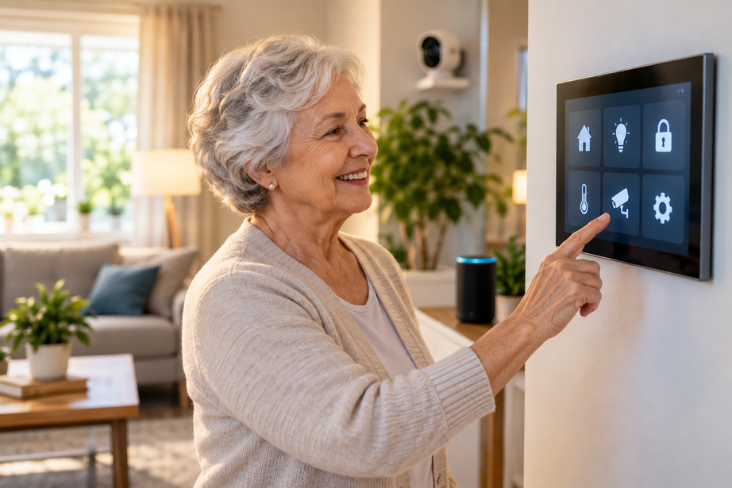
Home technology has become increasingly practical, and home automation for seniors can make everyday living more comfortable, accessible, and secure. From automatically switching on hallway lights to controlling heating with a voice command, connected technology can reduce physical effort while helping older adults maintain greater independence.
A thoughtfully designed smart home for seniors can combine lighting, heating, access control, security cameras, sensors, alarms, and emergency support into one easy-to-use environment. The goal is not to fill a property with complicated gadgets. Instead, we focus on selecting useful technology that addresses genuine needs and remains simple to operate.
For families and caregivers, connected systems can also provide greater peace of mind. Depending on the devices installed, authorized users may receive alerts, check cameras remotely, or manage certain aspects of the property when an older family member needs additional support. At AY Security Systems, we provide smart home automation installation in Harrow, with solutions tailored to individual requirements.
What Is Home Automation for Seniors?
Home automation involves using connected technology to control or automate different functions within a property. Instead of manually operating every light, thermostat, blind, appliance, or security device, homeowners can use smartphones, tablets, voice commands, sensors, or scheduled routines.
For older adults, accessibility is especially important. A system should be straightforward rather than technically overwhelming. Simple controls can allow a resident to operate several functions without repeatedly moving around the property or remembering multiple complicated procedures.
A smart home for seniors might automatically illuminate a hallway when movement is detected, adjust the heating according to a schedule, notify an authorized person when a door is opened, or provide remote access for a trusted family member or career.
How Smart Home Technology Works
A typical system can bring several technologies together, including:
- Connected devices that communicate through a compatible smart home platform.
- Mobile and tablet controls for authorized remote management.
- Voice assistants for compatible hands-free commands.
- Motion and door sensors that detect movement or changes in access.
- Automated schedules that perform routine actions at predetermined times.
- Notifications and alerts that provide information about selected events.
The best systems are planned around the resident’s routine, mobility, preferences, and existing security requirements.
How Smart Homes Can Improve Everyday Living for Seniors
Smart home technology can make daily routines easier for seniors by automating lighting, heating, security, and other household tasks while supporting comfort, accessibility, and greater independence.
1. Easier Lighting Control
Lighting automation can make a noticeable difference to everyday comfort. Motion-activated lighting can illuminate corridors, bathrooms, entrances, and stairways when movement is detected, reducing the need to find a switch in the dark.
Voice-controlled lighting can also allow residents to turn compatible lights on or off without walking across the room. Scheduled lighting can provide additional convenience by automatically switching selected lights on at appropriate times.
Night lighting is particularly useful around bedrooms, hallways, and stairs. Properly positioned automated lights can make movement around the property easier while reducing the need to reach awkward switches.
2. Automated Heating and Temperature Control
A smart thermostat can help manage indoor temperature through scheduled settings and remote controls. Rather than repeatedly adjusting a traditional thermostat, residents can use a simple interface or compatible voice command.
Heating schedules can also be created around normal daily routines. Family members or authorized caregivers may be able to adjust compatible systems remotely when appropriate.
The objective is consistent comfort without unnecessary complexity. A professional installation can help ensure that controls are positioned and configured in a practical way.
3. Voice Control for Everyday Tasks
Voice control can be particularly useful where reaching switches or handling small controls is difficult. Compatible systems may allow residents to:
- Turn lights on and off.
- Adjust compatible heating controls.
- Operate selected appliances.
- Open or close compatible blinds.
- Set reminders and routines.
- Control other connected devices.
Voice commands should complement, rather than replace, conventional controls so that residents have options if a particular technology is unavailable.
4. Automated Doors, Curtains and Blinds
Motorized blinds and curtains can reduce the physical effort required to open and close window coverings. Automated routines can also operate them at predetermined times.
Depending on the property and requirements, automated access solutions may similarly reduce the effort associated with traditional keys or manual entry. Any access system should be carefully configured so that convenience does not compromise security.
Smart Home Devices for Seniors: What Should You Consider?
Choosing smart home devices for seniors should begin with practical needs rather than the number of available features. Useful technology should be accessible, reliable, compatible, and easy to understand.
1. Smart Lighting Systems
Smart bulbs, switches, dimmers, and motion sensors can provide automated illumination throughout important areas of the home.
2. Smart Thermostats
Smart thermostats can provide scheduled temperature control and, where supported, remote management through a connected application.
3. Smart Doorbells and Cameras
Video doorbells and security cameras can help residents identify visitors without immediately opening a door. Remote viewing can also allow authorized family members to check the property when appropriate.
4. Motion and Occupancy Sensors
Sensors can detect movement and selected activity patterns. They can be used for lighting, security notifications, and other automation routines.
5. Smart Locks and Access Systems
Smart locks can provide keyless or controlled access. Depending on the system, different authorized users may receive appropriate access permissions.
6. Voice-Controlled Devices
Voice-compatible devices can provide hands-free control of selected smart home functions.
7. Smoke, Heat and Fire Detection Devices
Connected smoke and heat detection can provide early warnings and, with compatible systems, send notifications to designated contacts.
Interesting Read: Top Smart Devices to Include in Your First Home Automation Installation
Smart Homes for Elderly People: Everyday Tasks That Can Be Automated
Smart homes for elderly people can simplify everyday routines through automated lighting, heating, access, security, and other connected features that reduce effort and support greater independence.
| Everyday Task | Smart Home Solution |
| Turning lights on/off | Smart lighting |
| Adjusting temperature | Smart thermostat |
| Locking doors | Smart locks |
| Checking visitors | Video doorbell |
| Monitoring activity | Smart sensors |
| Calling for assistance | Emergency alert system |
| Controlling appliances | Smart plugs |
| Opening/closing blinds | Motorized blinds |
| Managing routines | Automated schedules |
These examples show how home automation for elderly residents can focus on ordinary activities rather than complicated technology. A system can be expanded gradually as needs change.
Improving Home Security for Older Adults
Security is an important part of a connected home. Automation can complement traditional locks, alarms, CCTV, and access controls by making selected security functions easier to manage and monitor.
Remote notifications can inform authorized users about specific events, such as detected movement or door activity. Depending on the system, family members or caregivers may also be able to access cameras or check the property remotely.
Privacy should always be considered when installing connected devices. Cameras should be positioned appropriately, accounts should use strong authentication, and access permissions should be limited to trusted individuals.
Home Monitoring for Seniors
A home monitoring solution may include:
- Door and window sensors.
- Motion detection.
- Activity monitoring.
- Remote notifications.
- Camera systems.
- Security alarms.
- Access monitoring.
These technologies can help families stay informed without unnecessarily interfering with an older person’s independence.
Emergency Alert Systems for Seniors
Emergency technology can provide an additional layer of support. Depending on the chosen solution, this may include personal emergency buttons, wearable alert devices, or compatible fall-related notifications.
Alerts can potentially be directed to family members, careers, monitoring services, or other designated contacts. However, technology should form part of a clear emergency response plan rather than being treated as a replacement for appropriate emergency services.
Security Features That Can Work With a Smart Home
Integrated security features can strengthen a smart home with connected CCTV, access control, alarms, and fire detection, helping seniors and families improve protection, awareness, and everyday peace of mind.
1. Home CCTV Installation
Professional home CCTV installation can provide indoor or outdoor surveillance where appropriate. Cameras may monitor entrances, driveways, gardens, or other relevant areas.
Remote viewing can allow authorized users to check selected cameras through compatible systems. Security notifications can also help draw attention to detected activity.
Interesting Read: CCTV Installation for Smart Homes: Integrating with Modern Home Automation
2. Door Access Control System for Home
A door access control system for home can provide more flexible management of entry. Smart locks and other access solutions may allow authorized family members or careers to enter without requiring a traditional key.
Some systems support temporary or scheduled access, which can be useful where different people need access at different times.
3. Fire Alarm System Installation
Professional fire alarm system installation can help protect residents through appropriate smoke and heat detection. Connected systems may also provide alerts beyond the immediate property when compatible technology is used.
Early warning is particularly important because residents need sufficient time to respond safely during a fire or other emergency.
Benefits of Senior Home Automation for Families and Caregivers
Well-planned smart homes for elderly residents can benefit more than the person living in the property. Families and caregivers may gain greater visibility into selected aspects of home security while allowing the resident to maintain independence.
Potential benefits include:
- Greater peace of mind.
- Easier remote check-ins.
- Faster awareness of unusual activity.
- Improved independence.
- Reduced repetitive manual tasks.
- Better visibility of security events.
- Flexible access management.
- Support for family members living elsewhere.
The right home automation for elderly residents should never be about surveillance for its own sake. Systems should respect privacy and independence while providing practical assistance where it is genuinely useful.
Interesting Read: How to Update and Maintain Your Home Automation System
Is Home Automation Suitable for Every Senior?
Home automation can be adapted to many properties, but it is not automatically suitable in the same form for every resident. Before installation, we consider factors such as:
- Familiarity with technology.
- Mobility and accessibility requirements.
- Property layout.
- Internet connectivity.
- Budget.
- Ease of use.
- Privacy preferences.
- Existing security equipment.
- Maintenance and support requirements.
The resident’s daily routine should remain central to the planning process.
Interesting Read: How to Set Up Home Automation Systems on a Budget
Choosing Simple Technology Over Complicated Systems
More technology does not necessarily mean a better solution. We recommend prioritising the features that solve genuine problems.
A senior may benefit more from automated hallway lighting, a simple smart thermostat, and a video doorbell than from a complicated system containing dozens of rarely used features.
Controls should be intuitive, instructions should be clear, and residents should have the opportunity to learn how the system works before relying on it.
Professional Home Automation Installation
Professional home automation installation can help ensure that individual devices work together correctly and are positioned appropriately throughout the property.
During planning, we can consider the placement of cameras, sensors, alarms, access controls, lighting equipment, and user interfaces. Compatibility is also important because connected devices need to communicate reliably within the chosen system.
For homeowners seeking home automation installation London services, professional planning can provide a more cohesive result than purchasing unrelated devices independently. Experienced home automation installers in London can also help configure and test equipment before handing the system over to the resident.
For properties in Harrow, working with a smart home installer in Harrow can make it easier to receive local installation, configuration, and support.
How to Choose the Right Home Automation Company
Choosing the right home automation company means considering experience, compatible technology, ease of use, installation support, security, and ongoing service to ensure a reliable smart home solution.
1. Look for Experience
Look for a company with experience in residential automation and integrated security systems. Practical experience matters when different technologies need to work together.
2. Consider System Compatibility
Devices should be selected for compatibility rather than simply chosen individually. A professionally planned system can reduce the risk of disconnected or difficult-to-manage equipment.
3. Priorities Ease of Use
The system should be understandable for the senior using it every day. Family members and caregivers should also understand any controls they are authorized to use.
4. Ask About Installation and Support
Consider whether the provider offers installation, testing, maintenance, troubleshooting, and future upgrades. Ongoing support can become especially valuable when requirements change.
5. Consider Security and Privacy
Connected devices should be configured securely. Strong passwords, appropriate access permissions, secure accounts, and thoughtful camera placement all contribute to responsible smart home management.
Why Choose AY Security Systems for Smart Home and Security Solutions?
At AY Security Systems, we focus on practical security and automation solutions for homeowners across London and Harrow. We understand that every property and every household has different requirements, particularly when technology is being introduced to support an older resident.
Our solutions can incorporate smart home automation, security system installation, CCTV installation, access control, fire alarm systems, and home monitoring according to the needs of the property.
Rather than relying on a one-size-fits-all package, we can help identify which technologies are genuinely useful and how they can work together. Professional installation, straightforward operation, appropriate positioning, system testing, and ongoing support are important parts of creating a dependable solution.
For homeowners looking for a home automation company in Harrow, or those seeking a security system installer in London, a tailored approach can provide a better balance between convenience, accessibility, security, and privacy.
Make Everyday Living Safer and Easier With Smart Home Technology
The right home automation for seniors can make everyday living more convenient while supporting independence, accessibility, and home security. Automated lighting can simplify movement around the property, smart heating can improve comfort, and connected access and security systems can provide additional protection.
For families and caregivers, carefully selected automation can also provide reassurance without unnecessarily compromising the senior’s privacy or independence. The most effective solution is not necessarily the most complicated one. It is the system that addresses real needs and remains simple to use.
At AY Security Systems, we provide tailored smart home and security solutions for homeowners in London and Harrow. From smart home automation services and CCTV to access control, fire alarms, and home monitoring, we can help create a connected system around the requirements of the property and its residents.
Contact AY Security Systems to discuss your home automation and security requirements and explore a practical solution designed for safer, easier everyday living.
Interesting Read: The Future Is Here: How Home Automation Is Changing Everyday Living
Frequently Asked Questions About Home Automation for Seniors
What is the best smart home technology for seniors?
The best technology depends on individual needs. Automated lighting, smart thermostats, video doorbells, access controls, sensors, and emergency alert devices are commonly useful because they can improve convenience and safety without requiring complicated daily operation.
How can home automation help elderly people live independently?
Automation can reduce the physical effort involved in everyday tasks. Lighting, heating, blinds, access, and selected appliances can be controlled automatically or through simple commands, helping older adults manage their homes more comfortably.
Are smart home devices easy for seniors to use?
They can be, provided the system is properly selected and configured. We recommend simple controls, clear instructions, limited unnecessary features, and demonstrations so residents understand how to operate the technology confidently.
Can family members monitor a senior’s home remotely?
Depending on the devices installed and the permissions provided, authorized family members may be able to receive selected notifications, view compatible cameras, or manage certain connected functions remotely.
What security devices are useful for older adults?
Useful options can include CCTV cameras, video doorbells, smart locks, door and window sensors, motion detectors, alarms, and connected fire detection systems. The appropriate combination depends on the property and resident.
Can smart home systems include emergency alerts?
Yes. Compatible systems can include personal emergency buttons, wearable alerts, and other notification technologies. Some devices can notify designated contacts when a specific event occurs.
Can CCTV be integrated into a smart home system?
Yes, compatible CCTV systems can form part of a broader smart home and security setup. This can allow authorized users to access cameras, receive notifications, and manage security functions through compatible interfaces.
Is professional home automation installation necessary?
Professional installation is not necessary for every basic smart device, but it can be valuable for integrated systems involving multiple technologies. Proper planning, positioning, configuration, testing, and user guidance can improve reliability and usability.
How much does home automation installation cost in London?
The cost varies according to the property’s size, the number of devices, system complexity, existing infrastructure, and the required level of integration. A professional assessment provides a more accurate estimate for the specific property.
Can an existing home be converted into a smart home?
Yes. Many existing properties can incorporate smart lighting, heating, security, access control, sensors, and other connected technologies. The installation approach depends on the property’s existing wiring, network, security equipment, and layout.
What should I look for in a smart home installer in Harrow?
Look for relevant residential experience, compatible technology, professional installation, clear communication, testing, security awareness, and ongoing support. It is also important that the installer understands accessibility and ease-of-use requirements.
Can smart home automation improve home security?
Yes. Automation can support security through cameras, sensors, smart locks, alarms, notifications, and access controls. These technologies can complement traditional security measures and provide authorized users with greater visibility.